
Alternative to Fractional GC and Lawyer on Board

I recently heard that, even in Japan, non–full-time arrangements for in-house legal roles are finally starting to be accepted. Based on my own experience, I wanted to write about this topic.
1. Fractional GC and Lawyer on Board
A Fractional GC (General Counsel) is, quite literally, a “partial” general counsel.
Instead of being employed full-time by a single company, a Fractional GC allocates a “fraction” of their time and commitment across multiple companies, providing GC-level support where needed.
For example, they might spend one or two days a week on-site at Company A to attend board meetings and management meetings, and then dedicate a few hours a month to Company B via online meetings to support international contracts and compliance matters.
“Lawyer on Board” builds on this Fractional GC concept.
It is not just an external advisor role; rather, it emphasizes stepping “onto the board” – getting inside the organization and being involved in actual decision-making.
Overseas, ALSPs (Alternative Legal Service Providers) such as Axiom have been launching Fractional GC services one after another. They provide flexible legal resources to companies that “do not yet need or cannot afford a full-time GC, but still require legal support at the management level.
In Japan as well, there are law firms that brand themselves around “Lawyer on Board,” combining on-site secondment, part-time support, and in-house outsourcing to offer lawyers who can function as part of a company’s internal legal team.
Firms such as Nozomi Sogo and TKI Law are also introducing models where they provide specialized GC services on a non–full-time basis – only for the hours and level of involvement that a company actually needs.
2. These ideas are finally being accepted in Japan
Although still at a fairly niche level, the idea that “a GC does not have to be full-time” is finally starting to gain recognition in Japan.
Until now, many Japanese companies have treated legal and compliance functions either as an extension of general affairs or accounting, or have taken the view that “legal must be done by a full-time, permanent employee.”
In many foreign companies, the head of legal is called the General Counsel and is typically involved in business decision-making as part of the executive team. In contrast, Japanese companies rarely use titles like GC or Chief Legal Officer (CLO); instead, they assume that a “head of legal” is someone who works full-time, on-site, and is 100% committed to a single company.
When legal recruiting agencies introduced in-house roles requiring English, I often said, “I could do this on a part-time basis,” only to be told many times: “If you can’t commit full-time, it won’t work. We’ll look for someone else.”
One reason is the structure of the traditional recruitment business model: agencies typically earn a fee based on a percentage of the candidate’s annual salary. From that perspective, placing a full-time hire is “more efficient” than placing a part-time one. So even if a candidate is available on a part-time basis, there is little incentive to seriously explore that option.
That said, if you look at many mid-sized and larger companies in Japan today, the reality often looks like this:
- They have cross-border deals and need English contract drafting and negotiation in 20–30% of their work.
- They cannot pay at the compensation levels of global companies where English is used constantly.
- Only a very small number of Japanese-qualified lawyers can truly handle legal work in English.
Once you recognize this reality, hiring a Fractional GC is, in many cases, simply the more efficient and rational option.
The reality that “almost no Japanese can draft English contracts”
In practice, even when companies want to entrust cross-border matters to someone, there are very few Japanese lawyers who can draft English-language contracts from scratch.
More people can now speak or read English to some extent. And many assume that, if someone holds a foreign bar qualification, they must naturally be able to use English in legal practice – but in reality, that is not always the case.
I want to add one more point to the idea that there are very few Japanese professionals who can actually draft contracts in English.
In my case, about one year after graduating university, obtaining BA in Law in Japan, I went straight to law school in New York without gaining any legal practice in Japan. As a result, I learned core legal concepts in English from the outset. Because of that, when I draft contracts, I do not translate from Japanese—I build them in English from the beginning. In fact, that is simply more natural for me.
This is not merely a matter of language. The gap is not just between Japanese and English, but between civil law and common law ways of thinking. Having internalized common law concepts first makes a significant difference in how contracts are structured, interpreted, and negotiated.
Such a difference becomes quite significant when it comes to cross-border matters. There is a substantial gap between “translating” a contract into English and “structuring” it in English from the outset. The quality of the provisions, the speed of negotiation, and the level of communication with opposing counsel are all affected. This is particularly true in entertainment and startup matters, where speed and nuance often have a direct impact on business outcomes.
These aspects are not always visible from the outside, but they are exactly the points I would urge you to pay attention to when assessing how far you can truly rely on someone for English‑language and common‑law work in cross‑border entertainment and startup matters.
Full-time in-house legal work can become monotonous
This is also my own experience: working as an in-house lawyer full-time at a single company can become monotonous.
Before moving into legal, I had worked in areas like promotion and as an artist manager. When I joined Hudson Soft (a company that no longer exists as it was later acquired by the KONAMI group) as a legal counsel, I remember being bored after just four days because there was so little to do.
The same types of contracts came in, and I made the same kinds of edits, day after day.
Fortunately, I later volunteered to handle overseas licensing deals and negotiations for music distribution contracts with labels and production companies, which made the work more engaging. But in subsequent companies too, I often felt that I simply finished drafting and reviewing contracts faster than others, which left me with more idle time than most.
I assume I am not alone. Many in-house lawyers spend their days sitting at their desks, waiting for contracts and internal queries to come in. When something urgent arises, they are pushed to work overtime, yet they are not necessarily thanked for it.
So they move from company to company in search of something better – and then get labeled as “job hoppers” because of their number of transfers. It is not a very fair or attractive situation.
3. Bringing flexible work-styles into legal
When I first came across the term “Fractional GC” recently, I felt that something I had been thinking about nine years ago was finally being recognized.
At that time, working as a legal recruiter, I teamed up with a very capable recruiter and a fellow law school graduate to design a talent service that would introduce part-time positions to “highly skilled mothers who could not work full-time because of childcare responsibilities.” We even submitted the idea to a business competition for women entrepreneurs.
In Japan, once women leave the workforce due to marriage or childcare and become full-time homemakers, it is often very difficult to “re-enter” their previous careers. At the same time, I saw many women in part-time roles delivering maximum performance within limited working hours.
We wanted to connect that underutilized talent with companies in a way that fit their life stages.
Our idea did not make it past the second round. Looking back, I suspect that the competition tended to favor projects that sounded more like “helping people,” “international,” or “traditionally feminine” over those that were more focused on business models.
On top of that, in Japan, recruitment is often seen as “making money by dealing in people,” so recruiters themselves are not always held in high regard. It may have been difficult for the judges to recognize the value of the business model itself.
In any case, I think our idea – “connecting highly skilled talent to companies on the assumption of flexible workstyles” – was perhaps a little ahead of its time.
Today, in my own practice, I handle LLP deals from my LA office on behalf of Japanese clients on the U.S. side, while in Japan I work at my Tokyo office for foreign clients on English-language matters. I am constantly moving between two jurisdictions.
More than 80% of my work is international, and because I understand both U.S. and Japanese perspectives, I am naturally drawn to a model where I am not fixed full-time to a single company as a GC, but instead provide GC-level support across borders and organizations.
The concepts of Fractional GC and Lawyer on Board feel like a natural extension of my career, and I believe they will become a very effective way for companies to hire and utilize legal talent going forward.
If Japanese companies are beginning to pay attention to flexible ways of using legal resources like these, that is a very positive development – both for businesses and for those of us who want to pursue diverse ways of working.
If your company is interested in exploring a Fractional GC / Lawyer on Board style of legal support, I would be happy to discuss your specific situation and consider together what kind of engagement might work best. Please feel free to contact me via the inquiry form.
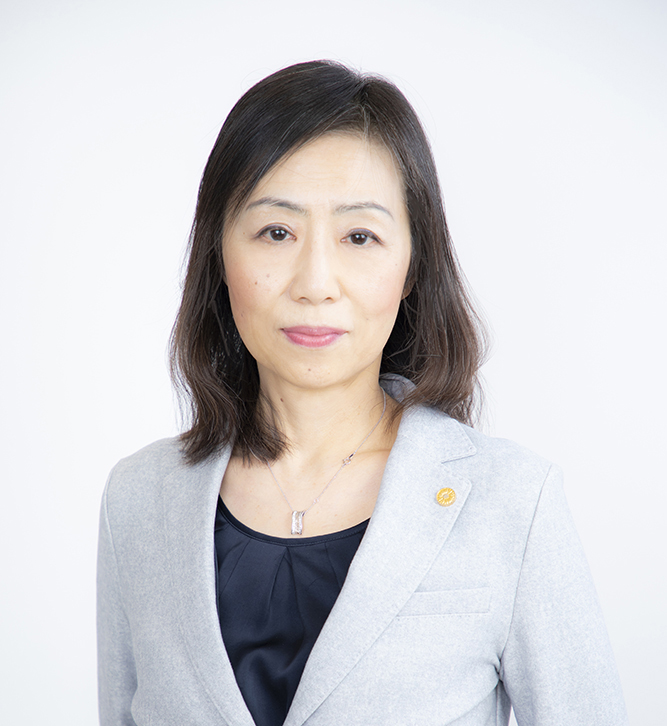 Ishibashi Legal Office
California Attorney
Representative
Junko Ishibashi
- Member- The State Bar of California
- Tokyo District Gyosei Shoshi Association- Member(Since 2007)
- Real Estate Transaction Manager, Business Copyright Upper License, Life Save Training Certification